

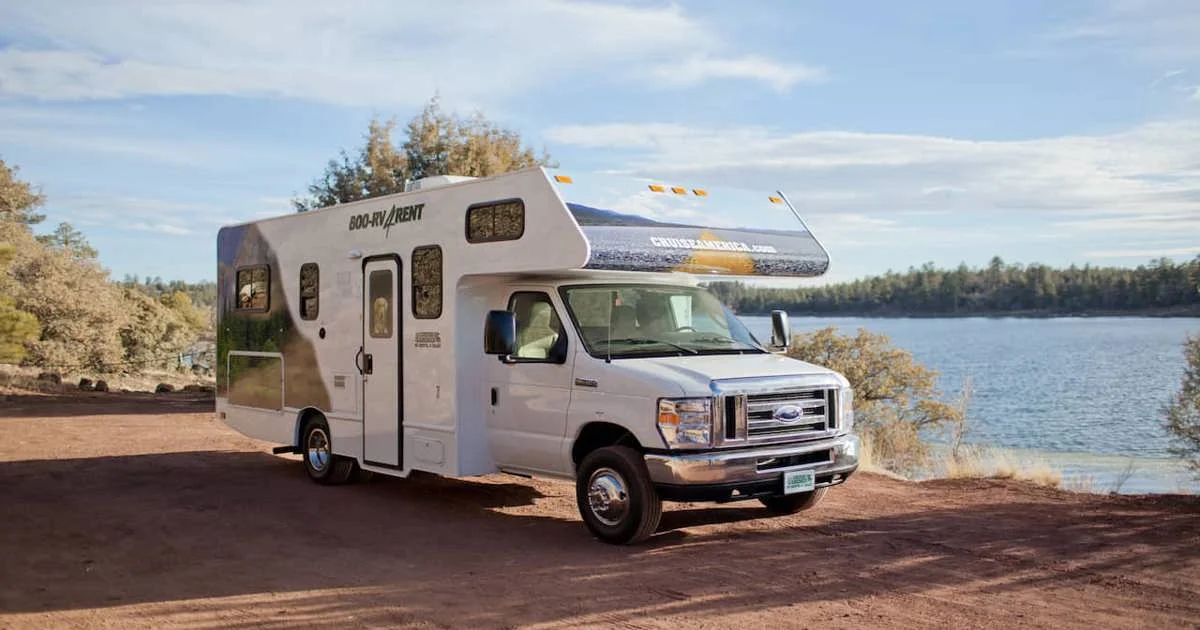
Cruise America sells the motorhomes it has finished renting, and its own sales page says in writing that its internal service records “were never formatted for public release.” Is buying an RV worth it? On a vehicle with no published history and no window form, that question is answered by what you can check yourself rather than by what the listing asks.
This is an independent editorial review. Cruise America did not review or approve this article.
This article is about the money and the paperwork, not about operating a motorhome. A rental or a purchase is governed by the agreement you sign and by the weight ratings and labels on the vehicle itself, so read both before you drive anything away.
You can see the company’s current lineup on its official site:
Is buying an RV worth it? Start with the four line items
The purchase price is the least interesting number in this category, because it is the only one that stops. Four line items carry on after it:
- Storage. A Class C motorhome does not fit most driveways or most residential rules, so a parking space is an ongoing charge from the first month you own it.
- Insurance and registration. Priced on the vehicle rather than on how often you use it, which means a rig driven three weeks a year costs the same to keep insured as one driven thirty.
- Maintenance on a schedule, not on use. Tires age out whether you drive or not. Cruise America’s own buying guide says tires “should be replaced every five to seven years, and you can decode the DOT number on the sidewall to learn their exact age.”
- Depreciation and the service contract. The company sells extended service contracts and says you “can cancel your warranty at any time” with “a pro-rated refund minus a small administration fee,” and that a contract is transferable “for a nominal one-time fee.”
Against that, the company describes what it is selling as a “well-maintained, commercial-grade Class C motorhome” that is “built to handle extensive travel and continue delivering years of enjoyment after its rental service is complete.” It says it buys its fleet vehicles new and “has maintained that vehicle from day one,” and that its used rental units “are kept in pristine condition, with regular maintenance and inspections after each rental period.” Those are the company’s claims about its own stock, and they are reasonable ones for a commercial fleet. They are also not a document you can read.
The cheaper alternative: what best budget rv rental actually covers
Renting is the honest comparison, not a fallback. Searching for a best budget rv rental gets you the same class of vehicle from the same company, with storage, insurance, registration, tires and depreciation all folded into somebody else’s balance sheet. The company runs sales locations in sixteen places in the United States and three in Canada, so the rig you would be buying is often parked at the counter you would otherwise be renting from.
The arithmetic that decides it is nights per year, not enthusiasm. Ownership makes sense when the vehicle is used often enough that the fixed charges above divide down to something small per night. Below that threshold, renting is cheaper by a wide margin and the margin gets wider every year the rig sits still.
The window sticker a used motorhome never gets
Here is the part almost nobody buying their first motorhome knows. The Federal Trade Commission’s Used Motor Vehicle Trade Regulation Rule, at 16 CFR Part 455, is why a used car on a lot carries a form in its window. Section 455.2(a) requires a dealer to “prepare, fill in as applicable and display on that vehicle the applicable ‘Buyers Guide'” before offering it for sale, and the FTC’s guide for dealers says that form tells the buyer “whether the vehicle is being sold ‘as is’ or with a warranty,” “that oral promises are difficult to enforce,” and “to ask to have the car inspected by an independent mechanic before they buy.”
Now read the rule’s own definition. Section 455.1(d)(1) defines a vehicle as “any motorized vehicle, other than a motorcycle, with a gross vehicle weight rating (GVWR) of less than 8500 lbs., a curb weight of less than 6,000 lbs., and a frontal area of less than 46 sq. ft.” A Class C motorhome is above all three of those limits. The rule’s listed exceptions are “motorcycles; any vehicle sold for scrap or parts if the dealer submits title documents to the appropriate state authority and obtains a salvage certification; and agricultural equipment,” so a motorhome is not excluded by name. It simply never enters the definition, because it is too heavy and too big.
The practical effect is that the single most useful piece of paper in the used-car world is absent from the most expensive vehicle an ordinary household will ever buy. Nothing is being hidden. The disclosure was written for a lighter vehicle and never grew.
That puts the inspection back on you, and the seller’s terms decide how that goes. Cruise America says it does “allow inspections before delivery, with a few items to note”: the inspection has to happen on company property, and “the buyer is responsible for paying all inspection fees, regardless of whether they finalize a sale.” Budget for that as a real cost, possibly more than once. Its own buying guide tells you what to look at:
- The roof and ceiling, for “questionable smells, stains on the ceiling, and cracked caulking on the roof.”
- The air conditioning, which should show “about a 20-degree difference from the outside temperature after the unit runs for 15 minutes.”
- The plumbing, by running the faucets and the toilet with water in the tank and then looking underneath for drips.
- The battery box, for corrosion on the terminals and a manufacturing date on the label.
- The tires, by their age rather than their tread, using the DOT number on the sidewall.
What an rv rental under $200 a night leaves out
A listing advertised as an rv rental under $200 a night is quoting a base rate, and the base rate is rarely the bill. Distance, power generation, bedding and kitchen packs, and the drop-off arrangement are all priced separately in this industry, and a short trip with long driving days can land well above the headline. None of that makes renting the wrong answer. It makes the headline the wrong number to compare against ownership.
The comparison that works is a whole year on both sides. Add every night you would realistically travel, price those nights at the all-in rental total rather than the base rate, and set that against the four line items above plus the purchase. Do it honestly and the answer usually arrives without argument.

Reading rv rental deals 2026 against an ownership year
Seasonal offers are real, and they move the threshold rather than erasing it. When you see rv rental deals 2026 promoted for shoulder-season weeks, treat them as a reason to test the trip before committing to the asset, which is exactly the role a rental plays for a first-time buyer.
| What you are comparing | Renting a few weeks a year | Buying used from a fleet | Buying used privately |
|---|---|---|---|
| Who carries storage and insurance | The company | You, every month | You, every month |
| Maintenance history | Not your problem | Held by the seller, not released | Whatever the owner kept |
| Window disclosure form | Not applicable | None required at this weight | None required at this weight |
| Inspection | Walkthrough at pickup | Allowed on company property, at your cost | Wherever you can arrange it |
| What you own at the end | Photographs | A depreciating vehicle | A depreciating vehicle |
Look along the maintenance row. A fleet seller that will not release records is still telling you more than a private seller who has none, because a commercial operator has a reason to keep a vehicle running that a weekend owner does not.
Where the money is genuinely wasted
The clearest waste is buying before renting the same class of vehicle at least twice. A motorhome is a house, a vehicle and a hobby at once, and two trips tell you whether you like all three.
The second is skipping the paid inspection to save its fee. On a vehicle with no required disclosure form and no released service history, that fee buys the only independent information in the whole transaction, and declining it means the purchase rests entirely on a walkthrough.
The third is financing a vehicle you will use a handful of weeks a year over a long term. Cruise America says it is “not a buy here, pay here entity” and works with outside banks, and that “usually, there are no prepayment penalties with any of our established internal lenders.” A loan without a prepayment penalty is worth more than a slightly lower rate on one that has it, because the escape route is the feature.
You can see the company’s current lineup on its official site:
Frequently Asked Questions
These come up once the sticker price stops being the main question.
Does a used motorhome come with a warranty?
Not automatically, and no federal form is required to tell you either way at this vehicle weight. Cruise America sells extended service contracts separately and says they can be canceled at any time for a pro-rated refund minus an administration fee. Read what any contract covers before treating it as a warranty.
Can I bring my own mechanic?
With this seller, an inspection is allowed before delivery but has to take place on company property, and you pay the inspection fee whether or not you go through with the sale. Treat that fee as part of the purchase budget rather than an optional extra.
Why can I not see the service history?
The company states plainly that its internal service records “were never formatted for public release,” while also saying it buys fleet vehicles new and has maintained them from day one. Both things can be true at once, which is why the physical inspection carries the weight here.
How many trips a year make ownership sensible?
There is no universal number, because storage and insurance rates vary widely by state and by vehicle. Work it out with your own quotes: get a storage price and an insurance quote first, add them to a realistic maintenance figure, then divide by the nights you genuinely expect to travel.
Bottom line
A used motorhome is bought without the one disclosure form that protects used-car buyers, from a seller that keeps its service history internal. That makes the paid inspection and an honest count of nights per year the two numbers that decide this purchase, and both of them are available before you spend anything.


