

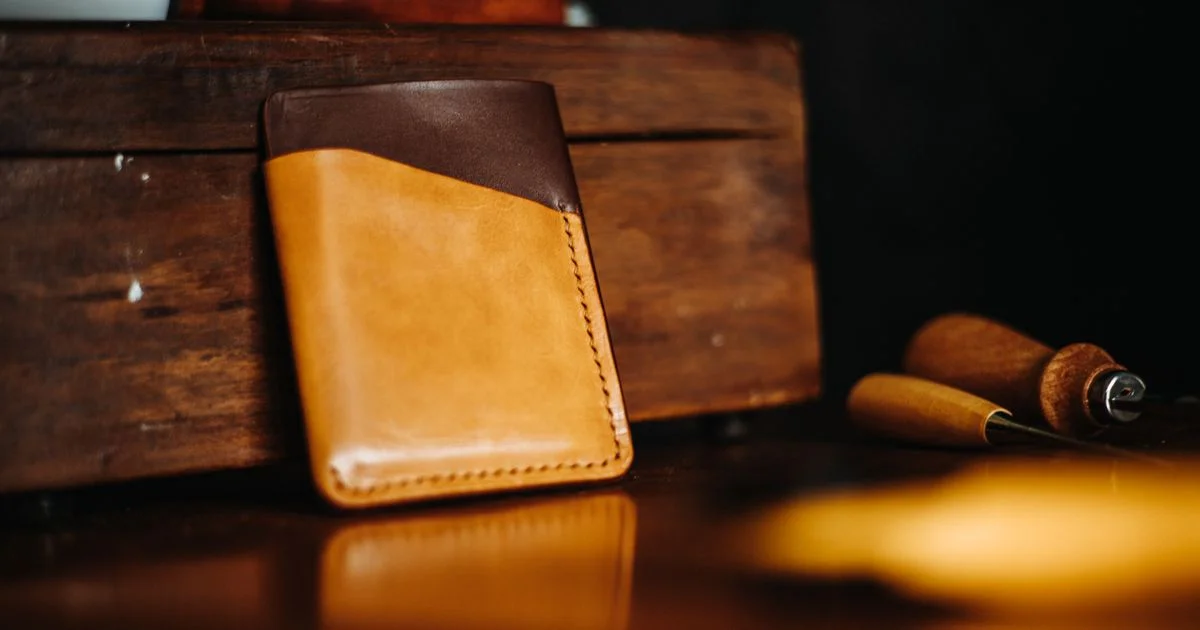
One word on a wallet’s tag does more to set its price than anything visible in the product photograph. An affordable smart wallet can carry the same card slots, the same pop-up mechanism and the same blocking claim as one costing three times more, and still be built from a material that federal advertising guides do not allow a seller to call leather without qualifying it. This guide sorts the differences you pay for from the ones that change nothing in your pocket.
Where the money goes in an affordable smart wallet
Four things set the price, and only two of them are visible in a listing photo. Sorting an affordable smart wallet from an expensive one starts with knowing which is which.
- The outer material. This is the single biggest price driver and the one most often described in words rather than facts. A full-grain hide, a split hide, a leather-fiber composite and a coated fabric can all photograph the same way.
- The card mechanism. A plain slot costs almost nothing. A spring-loaded fan, a pull tab or a machined aluminum cage costs more to make and is the part that wears out first.
- The electronics. A tracker adds a real component, a battery and an app. A blocking layer adds a sheet of foil and costs the maker almost nothing.
- The stitching and edges. Hand-finished edges and a high stitch count take labor. This is where a genuinely well-made wallet earns its price, and it is the hardest thing to see online.
Everything else on a spec sheet, including card capacity, cash strap and color choice, costs the maker roughly the same at every tier.
You can check current options here:
Check on Amazon See on Walmart
What you actually get in a smart wallet under $60
The honest read on a smart wallet under $60 is that the budget goes to one feature, not several. A maker at that level can afford a good hide with a plain slot layout, or a clever mechanism wrapped in a coated fabric, but rarely both.
What the entry tier reliably delivers: a working card holder, a blocking layer if it is advertised, and a slim profile. What it usually gives up: edge finishing, a replaceable elastic band, and any kind of published material breakdown. What it almost never includes: a user-serviceable tracker whose battery you can change yourself.
Moving up a tier buys finishing and materials. Moving up two tiers mostly buys a brand and a presentation box.
The word leather is a price, not a material
This is the most useful thing a buyer can learn about this category, and it is free. The Federal Trade Commission publishes Guides for Select Leather and Imitation Leather Products at 16 CFR Part 24, and they set out what the words on a tag are allowed to mean.
Under Section 24.2, the unqualified term “leather” may be used only where the product “is composed in all substantial parts of leather.” Where a product is made of a non-leather material that looks like leather, the Guides say the fact that it is not leather should be disclosed, with examples including “Not leather; Imitation leather; Simulated leather; Vinyl; Vinyl coated fabric; or Plastic.”
The provision that matters most at the low end is Section 24.2(f). Material containing “ground, pulverized, shredded, reconstituted, or bonded leather” should not be represented as leather, and where those terms are used the disclosure should state “the percentage of leather fibers and the percentage of non-leather substances.” The Guides give the form directly: “Bonded Leather Containing 60% Leather Fibers and 40% Non-leather Substances.” Section 24.2(g) adds that the disclosure belongs “on a tag, label, or card attached to the product” and “in all advertising.”
That turns a vague shopping question into a specific one you can answer before paying:
- Find the word the listing uses for the outside of the wallet, not the word in the headline.
- If it says leather with no qualifier at all, the seller is claiming a hide throughout.
- If it says bonded, reconstituted or leather fiber, look for the two percentages. Their absence is itself information.
- If it says vegan, PU, microfiber or coated, you are buying a plastic-faced fabric, which may be the right choice but should not be priced as a hide.
- Compare that word against the price before you compare any feature list.
A composite outer is not automatically a bad purchase. It is a bad purchase at hide prices, and it wears differently: a coated fabric tends to crack along fold lines rather than soften.

Free versus paid protection: is smart wallet worth it for card security
Blocking layers are the headline feature in this category, so the value question behind is smart wallet worth it comes down to what the protection is actually worth in dollars. The answer is capped, and it is capped by law rather than by the wallet.
The Federal Trade Commission’s consumer guidance on lost or stolen cards states that for a credit card “the maximum you might be responsible for is $50” in unauthorized charges. For an ATM or debit card the exposure is tiered by how fast you report it: nothing if you report before any unauthorized use, $50 if you report within two business days of discovering the loss, $500 if you report more than two business days later but within 60 calendar days after your statement is sent, and, beyond 60 calendar days, “all the money taken from your ATM/debit card account, and possibly more.”
Read that as a price list. The protection a wallet can sell you sits on top of a federal cap that already exists, and the variable that moves your real exposure by hundreds of dollars is how quickly you notice a card is gone. A $12 card holder you check every evening protects you better than a $90 one you never open.
The cheaper alternatives are genuinely competitive here. Card alerts from your bank are free and turn a 60-day clock into a same-minute one. Freezing a card in the issuer’s app is free. Carrying two cards in two places costs nothing at all.
What to read before a smart wallet deals 2026 listing
Discount season rewards buyers who already know the material vocabulary, which is why a smart wallet deals 2026 listing is worth approaching with the tag rather than the percentage in mind. The steepest reductions in this category tend to sit on composite-outer models, because the maker’s cost floor is lowest there.
Three checks keep a sale honest. Look for the material wording in the specification block rather than the marketing copy. Check whether the tracker, if there is one, needs a subscription or an app account to do anything useful. And confirm whether the battery is replaceable, because a sealed cell turns the wallet into a dated product rather than a durable one.
| Tier | Typical outer | Card mechanism | What it costs you later |
|---|---|---|---|
| Entry | Coated fabric or composite, sometimes undeclared | Fixed slots or a simple elastic band | Cracking along fold lines; band loses tension |
| Mid-range | Split hide or a declared full hide in smaller panels | Pop-up fan or pull tab | Mechanism wear before the material fails |
| Premium | Full-grain hide, finished edges | Machined cage or hand-stitched slots | Mostly your own carelessness; these outlast their owners’ interest |
| Tracker models | Any of the above | Any of the above | Battery or app support ends before the wallet does |
Where the money is genuinely wasted
Three upgrades in this category take real money and change very little in daily use.
The first is paying a premium for a blocking claim on its own. The liability rules above put a ceiling on what that feature can save you, and it adds pennies to the maker’s cost, so it belongs on the list of things a wallet should include rather than things you should pay extra for.
The second is capacity you will not use. A twelve-card wallet is thicker, more expensive and harder to close than a six-card one, and the cards you rarely touch are safer at home anyway.
The third is a sealed tracker. A tracker is genuinely useful, but when the cell cannot be changed, the useful life of an otherwise indestructible object is set by a battery. Paying hide money for that combination is the worst value in the category.
Money that is well spent: declared materials, finished edges, and a shape that fits the pocket you actually use. The same pattern shows up across everyday carry, where the price of a cable organizer bag tracks its materials and finishing far more closely than its feature list.
Frequently Asked Questions
A few questions come up repeatedly once the material and liability points are clear.
Does a cheaper wallet block cards less effectively?
Blocking is a physical layer rather than a graded feature, so a low-priced model that includes it is not necessarily worse at it. The harder thing to verify at any price is whether the layer covers every slot, which a listing rarely states.
Is bonded leather ever the right choice?
Yes, when it is priced as what it is. The Guides at 16 CFR Part 24 exist so the percentages are disclosed rather than hidden, and a clearly labeled composite at a composite price is a fair purchase.
How long should a wallet at this price last?
A declared hide with stitched edges should outlast several phones. A coated fabric outer typically shows fold-line damage first, and that damage is cosmetic long before it is structural.
Do I need a tracker if my cards are already protected?
The federal caps cover unauthorized card use, not the cost and time of replacing a driver’s license, a transit pass or keys. That is the honest case for a tracker, and it is a different argument from security.
Bottom line
Price in this category tracks the outer material and the finishing, and the words describing that material are governed by a published federal guide you can read in five minutes. Spend on a declared material and a shape you will carry, treat blocking as a feature rather than a reason, and let a free bank alert do the work a premium wallet cannot.


