

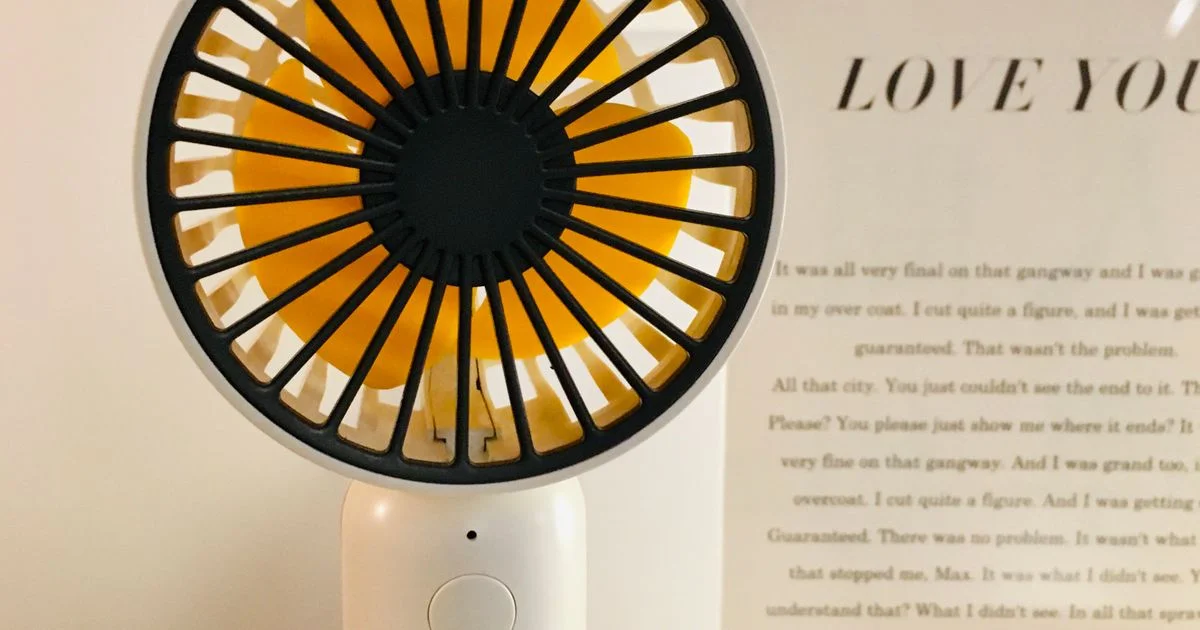
There is an air temperature above which a federal agency tells you to stop using a fan, and it is lower than a great many summer afternoons. That single line reframes the whole category, because a cheap portable neck fan is bought to solve heat and the agencies that study heat say a fan is not what solves it. Understanding exactly what moving air can and cannot do is the difference between a genuinely useful twenty-dollar purchase and a gadget that ends up in a drawer by August.
This is an independent editorial comparison. We are not affiliated with any brand mentioned, and no brand reviewed or approved this article. It is general consumer information drawing on published guidance from the EPA, the CDC, the National Weather Service and a Consumer Product Safety Commission recall notice. Heat illness is a medical emergency; this is not medical advice. Any wearable product with a lithium-ion battery should be charged on a hard surface, away from bedding, and taken out of service if it swells, smells or gets hot.
What a cheap portable neck fan actually costs to own
The shelf price is almost the whole purchase price here, which is unusual and worth saying plainly. There is no filter, no pad, no app and no plan. The costs that matter are different ones.
- The battery. Sealed, not user-replaceable on most units, and the part that decides when the product stops being a product.
- The charging time. A wearable fan is useless while it charges, so a single unit covers one outing a day.
- The disposal. A lithium-ion device cannot go in household trash, and that is a real errand rather than a theoretical one.
- The seasons. Roughly three months of use a year, which makes cost-per-hour a harsher number than it looks.
Divide by that last line and the arithmetic is unforgiving. A wearable fan used on genuinely hot days is used a few dozen times a summer. If it survives two summers, it is a good buy at almost any entry price. If the battery dies after one, it was expensive whatever it cost.
The free alternatives a federal agency recommends first
Before comparing fans, it is worth reading what the agencies actually recommend, because the list is short and most of it is free.
The CDC’s own guidance for people without air conditioning is direct: “While electric fans might provide some comfort, when temperatures are really hot, they won’t prevent heat-related illness.” What it suggests instead is taking cool showers or baths, drinking more water than usual, spending time in air-conditioned public spaces such as shopping malls or libraries, using the stove and oven less to keep the home cooler, checking on others with a buddy system, and contacting the local health department about air-conditioned shelters.
Every item on that list costs nothing or close to it. A library card and a cold shower outperform any wearable fan on the days that actually matter, and the honest framing of this category is that a fan is a comfort purchase for warm days rather than a safety purchase for hot ones.
What a budget portable neck fan gives up
A budget portable neck fan is a small motor, a battery, a switch and a guard. The places manufacturers save are predictable, and only some of them matter.
- Battery capacity, and honesty about it. Runtime claims are almost always quoted at the lowest speed. The number that matters is runtime on the setting you will actually use, which is usually the highest one.
- The blade guard. On a device worn at the neck, beside hair, the mesh or blade geometry is the specification worth examining in person.
- Noise. A fan two inches from your ear is a different acoustic proposition from one across a room, and it is the most common reason these end up unused.
- Fit and weight. A unit that pulls on the neck after twenty minutes will not be worn for an hour, regardless of what it cost.
What a cheap unit generally does not give up is airflow. Moving air is a solved and inexpensive engineering problem, and the gap between entry and premium on raw output is much narrower than the gap on comfort, noise and battery life.
Where an affordable portable neck fan stops working
This is the section that should decide the purchase. An affordable portable neck fan has a hard physical ceiling, and the EPA states it in one sentence: “Portable electric fans do not cool air. They just move the air around and keep you cool by helping to evaporate your sweat.”
Follow that mechanism and the limits fall out. The same EPA guidance advises: “Do not use electric fans for cooling when the room temperature is in the mid-90s or higher,” and adds “Do not use an electric fan in a closed room.” Above that threshold the air being moved across you is no longer cooler than you are, and the fan is working on evaporation alone.

Humidity is the other half of it. The National Weather Service defines the heat index as “a measure of how hot it really feels when relative humidity is factored in with the actual air temperature”, and notes that because the index assumes shade and light wind, “exposure to full sunshine can increase heat index values by up to 15 degrees Fahrenheit.” A fan works by helping sweat evaporate; in humid air, sweat evaporates less readily, so the same fan does less. On a humid ninety-degree day in direct sun, the product is delivering the least of what it is capable of at precisely the moment you bought it for.
None of this makes the category worthless. It makes it a warm-day comfort item: a commute, a stadium seat, a kitchen in July, a walk at eighty-five degrees in the shade. Price it for those and it is good value. Price it as protection against a heat wave and the agencies disagree with you.
The recall that sat in the portable neck fan under $25 band
Anyone shopping for a portable neck fan under $25 should know what the federal recall record looks like in that band, because there is a recent and specific entry.
On October 9, 2025 the Consumer Product Safety Commission announced recall number 26-008, covering about 48,000 Living Glow five-in-one portable waist fans, model CP-WFLED01, manufactured by Guangzhou Jiguang Lighting and sold on HSN.com and the HSN television network between May and July 2025. The hazard, in the CPSC’s own words: “The lithium-ion batteries can overheat while charging, posing a fire hazard.” The notice records four reports of the fans melting or catching fire, with no injuries or property damage reported. The remedy is a full refund on registration, and consumers are told to disable the device and dispose of it through a household hazardous waste collection center. The CPSC records the units as having sold for between $20 and $25.
Read that carefully rather than alarmingly. Four incidents across 48,000 units is a small rate, nobody was hurt, and the system worked exactly as designed. The useful lessons are about cost rather than fear.
- The battery is the product. On a sealed wearable, a battery fault is not a repair; it is the end of the device.
- A refund is not free. The remedy required registering, disabling the unit and driving it to a hazardous waste site. That is an afternoon.
- Charge it where a fault would be boring. The recall hazard was specifically about charging. A hard surface away from soft furnishings costs nothing.
- Register the product. It is the only way the recall notice reaches you rather than a news feed.
What each tier actually delivers
| Tier | What you get | Where it falls short | Honest use case |
|---|---|---|---|
| Entry wearable | Basic airflow, short runtime at high speed, sealed battery | Noise at the ear, neck fatigue, one charge per outing | Short commutes and errands on warm days |
| Mid-range wearable | Better fit, quieter motor, longer runtime, sometimes bladeless | Still cannot cool air, still sealed | A full day out in warm, dry conditions |
| Handheld or desk fan | Larger blades, often replaceable power, much cheaper per unit of airflow | Occupies a hand or a surface | Anywhere you can put it down |
| Free measures | Shade, water, a cool shower, an air-conditioned public building | Requires being somewhere specific | The only option the CDC endorses for genuinely hot days |
A plain handheld fan deserves more attention than it gets in this comparison. It costs less, usually runs longer, and puts the motor away from your ear, and a household that owns any other small air-moving appliance already knows that the quiet one is the one that gets used.
Where the money is genuinely wasted
The expensive mistakes in this category are consistent.
- Buying on a headline runtime. That figure is a lowest-speed number. Assume the useful setting roughly halves it.
- Buying a second unit instead of a charger. Two fans and one cable is a worse setup than one fan and a small power bank you already own.
- Buying for a heat wave. The agencies are explicit that this is the scenario a fan does not address. That money belongs on shade, water and somewhere cool to sit.
- Buying the multi-function version. Fan, flashlight, power bank in one body means one battery serving three jobs and one failure ending all three.
Frequently Asked Questions
Almost every question about this category is really a question about what a fan physically can do. Here are the four that come up most.
Does a neck fan actually lower the temperature?
No, and the EPA says so directly: portable electric fans do not cool air, they move it around and help sweat evaporate. Any cooling you feel is your own evaporation being accelerated, which is why the effect shrinks as humidity rises.
Is it safe to use one in very hot weather?
The EPA advises against using electric fans for cooling when the room temperature is in the mid-90s or higher, and the CDC says fans will not prevent heat-related illness when temperatures are really hot. Treat a wearable fan as a comfort item for warm days and follow the agencies’ advice on hot ones.
Are the cheapest ones a fire risk?
A recent CPSC recall of about 48,000 wearable waist fans cited lithium-ion batteries overheating while charging, with four reported incidents and no injuries. That is a low rate rather than a verdict on the category. Charge any sealed battery device on a hard surface away from bedding, register the product, and stop using it if it swells or runs hot.
Is a handheld fan better value?
Often, yes. It typically costs less, runs longer, and keeps the motor away from your ear, which is the most common reason wearable fans stop being worn. The wearable earns its premium only when you need both hands free.
Bottom line
A wearable fan is a fair-value comfort purchase for warm days and a poor substitute for shade, water and air conditioning on hot ones. Buy the quietest one that fits, charge it somewhere sensible, and spend nothing extra on a runtime figure measured at a speed you will never use.


