

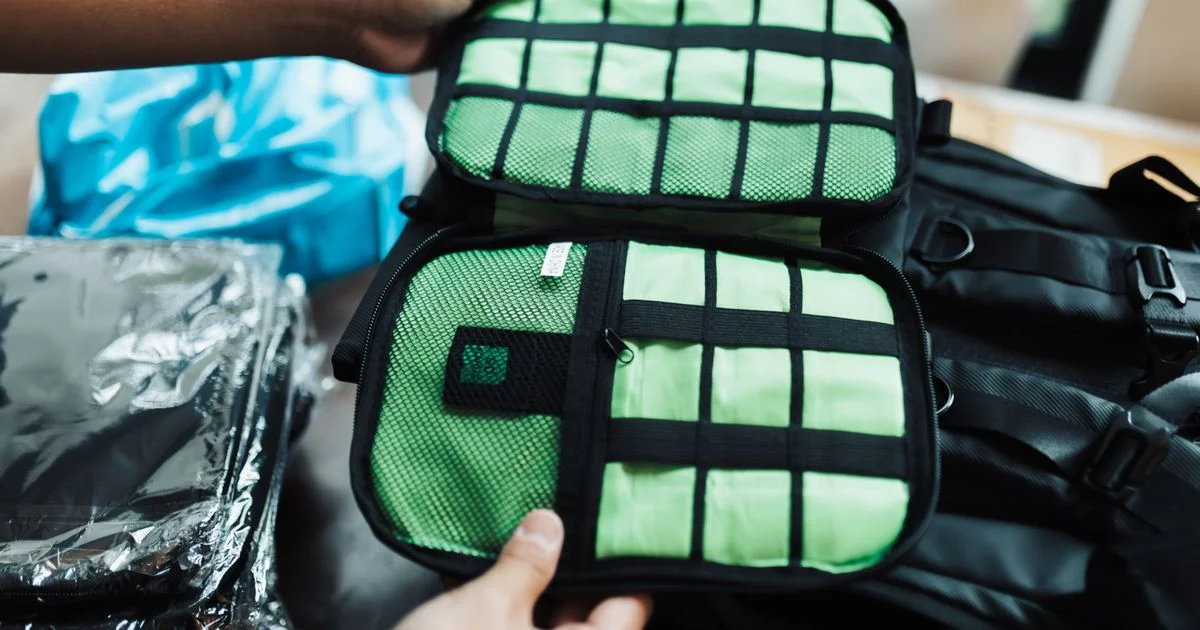
Federal law makes a sleeping bag tell you what it is made of. It exempts the bag you carry it in. That single asymmetry explains more about a cable organizer bag price than any spec sheet does, because the fiber content of a pouch is the one thing nobody is obliged to disclose and the warranty behind it is the one thing somebody is.
This is an independent editorial comparison. We are not affiliated with YKK, and no brand reviewed or approved this article.
Where a cable organizer bag price actually comes from
A cable pouch is four things stitched together, and only one of them is fabric. Sorted by how often each is the reason a bag gets thrown away, the order runs backwards from the order they get advertised in.
- The zipper. The part handled every single time, and the part that jams, splits or loses its puller first.
- The elastic webbing or mesh. Stretched and released constantly, and it goes slack long before it tears.
- The shell fabric. Rarely the failure, and the thing the listing talks about most.
- The stitching at the corners and the panel ends. Invisible in photographs and the difference between three years and ten.
There is no recurring cost here at all, which makes this an unusually clean value question. A pouch has no consumable, no subscription and no battery. The entire calculation is how many years it lasts divided by what it cost, which means the only two things worth investigating before buying are how it is built and what happens if it fails.
Free and cheaper alternatives: a basket, a drawer, a rubber band
For cables that never leave the house, the honest competition is a wire basket on a shelf, a drawer with a divider, or a rubber band per cable. None of them costs anything extra, none of them can break, and none of them is meaningfully worse at the job of keeping four chargers in one place.
What a pouch buys is not tidiness. It is the ability to pick up every cable at once, and the fact that a zipped enclosure keeps a loose USB end from catching on something. If the cables live on a desk and stay there, that benefit is close to zero and the basket wins by the whole purchase price.

The same distinction decides a lot of desk spending, and it runs through our look at what is worth paying for in a gaming desk with cable management: routing cables that stay put is a furniture problem, and carrying cables that move is a bag problem. Paying bag money for the first job is the common mistake.
What a cheap cable organizer bag gets right
A cheap cable organizer bag is genuinely sufficient in one clearly defined case: low handling frequency. A pouch opened twice a month in a drawer at home will outlive the phone whose charger it holds, whatever it is made of, because almost nothing in it is being worked. Spending up in that situation buys a nicer object rather than a longer-lasting one.
The case flips at the other end of the scale, where the same pouch is opened several times a day, dragged out of a full backpack by its zipper, and packed around hard-edged objects. Failure here is a function of handling rather than of time, and the cheap option is a bad bet only for people who will actually handle it.
The fabric claim nobody has to prove
The Textile Fiber Products Identification Act is why a T-shirt carries a fiber-content label. The Federal Trade Commission’s own guidance says that “In general, most clothing and textile products commonly used in a household are covered by the labeling requirements”, and the covered list is long and specific: clothing, handkerchiefs, scarves, bedding, “Curtains and casements”, draperies, “Tablecloths, napkins and doilies”, “Floor coverings: rugs, carpets and mats”, towels, “Ironing board covers and pads”, “Umbrellas and parasols”, cushions, “Furniture slip covers”, “Afghans and throws”, hammocks and — the one that matters here — “Sleeping bags”.
Then comes the exemption list, which includes, verbatim, “Textiles used in handbags or luggage, brushes, lampshades, toys, feminine hygiene products, adhesive tapes and adhesive sheets, cleaning cloths impregnated with chemicals, or diapers.” Belts get similar treatment: they are not covered unless fiber content is mentioned in the first place.
So a sleeping bag has to be labeled and a carrying case does not. That does not mean sellers are lying about fabric; plenty state a denier figure voluntarily, and a voluntary claim is still one a seller can be held to. It does mean the absence of a fiber label tells you nothing, and that comparing two unlabeled bags on “premium nylon” compares two pieces of marketing copy. Which is convenient, because the fabric is not what breaks.
Where a budget cable organizer bag starts to cost you
What breaks is the zipper, and the zipper is the one component with a public vocabulary. YKK, whose zippers turn up across the category, publishes three families. Its coil zipper is “made of spiral plastic elements, including polyester and nylon” and is offered in sizes it lists as 2CF, 3CF, 45CF, 5CNF, 8CF and 10CF; the company calls it “the most popular zipper among YKK’s three zipper types” and notes it “can be used in anything from apparel to luggage to sporting goods and even automobiles.” Its molded family, VISLON, is “made of injection molded plastic elements, such as a polyacetal resin”, comes in 3VS, 4VS, 5VS, 8VS, 10VF and 15VF, and is “lighter weight than metal zippers of the same size.”
The useful part for a shopper is the code itself. YKK’s own glossary maps the letters plainly: coil codes begin with a C, metal codes with an M or an R, and molded VISLON codes with a V, with “CF = Coil” and “CNF = Coil(#5 Only)”. A puller carrying a readable code tells you the family and the size designation, and a larger number is a heavier chain. That is a check anyone can run in a shop in four seconds, and a budget cable organizer bag that carries no marking at all is not necessarily bad — it is simply a bag whose most load-bearing part is undocumented.
The second thing that costs you later is that neither failure is repairable in any practical sense. A slack elastic panel cannot be re-tensioned and a split coil cannot be replaced without unpicking the bag. Once either goes, the pouch is finished, and the pouch was the cheap part.
What makes an affordable cable organizer bag worth keeping
An affordable cable organizer bag becomes a good purchase rather than a cheap one at the point where somebody has put their obligations in writing, and here the law is unexpectedly helpful. The Magnuson-Moss Warranty Act requires that written warranties on consumer products costing more than $10 be titled either “full” or “limited”, and the FTC’s guidance sets out what a “full” warranty has to meet, in all five parts:
- “You do not limit the duration of implied warranties”
- “You provide warranty service to anyone who owns the product during the warranty period”
- “You provide warranty service free of charge”
- “You provide, at the consumer’s choice, either a replacement or a full refund if, after a reasonable number of tries, you are unable to repair the product”
- “You do not require consumers to perform any duty as a precondition for receiving service, except notifying you that service is needed, unless you can demonstrate that the duty is reasonable”
If any one of those fails, the warranty is “limited” — which most are, and which is not a criticism. The word is a disclosure, and its presence means somebody has read the five conditions and decided which ones they cannot meet.
Better still, the Pre-Sale Availability Rule covers products costing more than $15 and requires sellers to make the warranty “readily available to prospective buyers either by displaying them in close proximity to the warranted products, or by furnishing them upon request prior to sale and posting prominent signs.” Catalogs have to carry the text or say how to get it. In other words: you are entitled to read the warranty before you pay, and for a product with no consumables and no running cost, that document is the entire value proposition. One more piece of FTC guidance is worth carrying into the shop — advertisements promising a “lifetime” should make clear which life is meant, the product’s useful life, the first owner’s period of ownership, or the first owner’s lifetime. Three very different promises share one word.
What you get at each tier
| What changes | Entry-level | Mid-range | Premium |
|---|---|---|---|
| Fiber content | Not stated, and not required to be | Stated voluntarily | Stated with a coating named |
| Zipper marking | No readable code on the puller | Family and size code present | Larger size code, molded chain |
| Elastic panel | Sewn at the ends only | Bar-tacked at each loop | Bar-tacked, with a padded backing panel |
| Warranty | None stated anywhere | Limited, with a stated term | Limited, with a stated repair route |
| Interior layout | One open cavity | Loops plus a zipped mesh pocket | Loops, mesh, and a padded slot |
| What you notice daily | The zipper dragging | That it closes | That it closes one-handed |
Three questions get you through a shop without reading a single spec sheet:
- Pick the bag up by its zipper puller and look for a code on it.
- Pull one elastic loop to its limit and watch whether the stitching at its ends moves.
- Ask to see the warranty, which you are entitled to read before paying.
Where the money is genuinely wasted
- Paying up on fabric, which is neither the failure point nor a claim anybody is required to substantiate.
- Buying a travel-grade pouch for cables that live in a drawer, where a basket does the same job for nothing.
- Buying the larger size on the theory that it will be filled, then carrying the weight of empty loops for years.
- Treating “lifetime” as a term rather than a word that needs defining before it means anything.
- Replacing a whole pouch because one elastic loop went slack, when the loops that still grip are the ones actually in use.
Frequently Asked Questions
Three questions come up repeatedly once fabric is off the table as a deciding factor, and all three have short answers.
Is a hard-shell cable case better than a soft pouch?
Only if something in it needs protecting from being crushed, which for cables is almost never true. A hard shell adds weight and takes a fixed volume in a bag whether it is full or empty. Soft pouches compress around whatever is left in them, which is usually worth more than the protection.
How long should a cable organizer bag last?
Long enough that time is the wrong unit. Handling is the right one: a pouch opened twice a month and a pouch opened three times a day are being asked for wildly different service lives from the same zipper. Judge it on how often you will open it, not on how many years the listing implies.
Do the elastic loops need to match the cables?
Loosely, yes, and it is the one layout detail worth checking in person. A panel of identical narrow loops holds thin cables well and refuses to hold a wall charger, and a panel of wide loops lets thin cables slip straight out. A mixed panel is the only one that suits a real collection, and no photograph makes that obvious.
Bottom line
This is a purchase with no running cost, so the whole question is durability, and the two things that decide it are the zipper and a document you are legally entitled to read before paying. Check the puller for a code, pull one loop hard, ask for the warranty, and ignore the fabric copy entirely.


2 Comments
Comments are closed.