

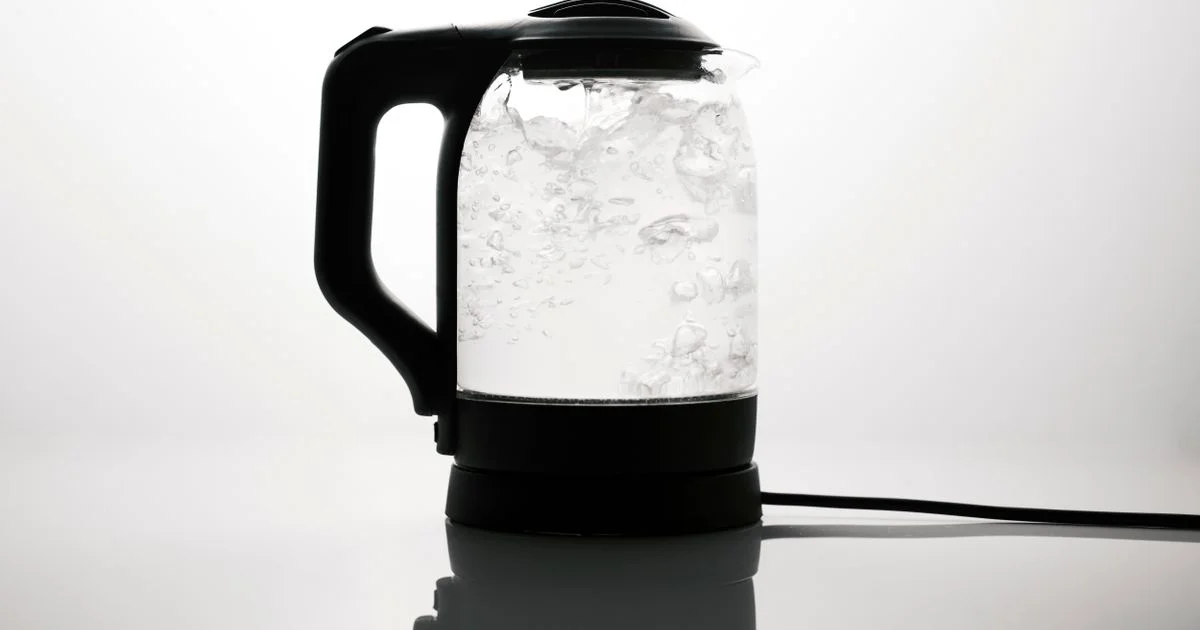
Kettles are one of the few countertop appliances where the physics sets the ceiling and the brand only decides how the ceiling is decorated. An affordable electric kettle boils water at almost exactly the same speed as an expensive one, for almost exactly the same electricity, because both are plugged into the same 120-volt wall socket — so the money you spend above the entry tier is buying convenience and durability, not performance.
This is an independent editorial comparison. We are not affiliated with any brand mentioned, and no brand reviewed or approved this article.
Where the money in an affordable electric kettle actually goes
Three numbers govern what an affordable electric kettle costs you over its life, and only one of them is printed on the shelf tag.
- The wattage, which is capped by your wall. A standard US 120-volt, 15-amp outlet tops out around 1,800 watts, which is why almost every kettle sold here clusters at 1,500 watts. A UK kettle on 240-volt mains can draw 3,000 watts and boils in roughly half the time. That gap is a grid limitation, not a product tier, and no amount of spending closes it.
- The energy per boil, which barely moves. Heating water takes a fixed amount of energy. Inside Energy, working with a National Renewable Energy Laboratory researcher, put 500 milliliters from room temperature to boiling at 165,000 joules, or 0.046 kilowatt-hours. A faster kettle gets there sooner using roughly the same energy; it does not get there cheaper.
- The parts that fail. The lid hinge, the gasket, the switch and the base contacts. These are what separate a kettle you replace in eighteen months from one you keep for six years, and they are the only place where spending more reliably returns something.
Put together, that means the running cost of a kettle is set almost entirely by how much water you put in it, and the purchase cost is best judged on how long the thing survives daily use.
The cheaper option you already own
Before buying anything, it is worth knowing how much an electric kettle actually saves against the appliances already in the kitchen. The same Inside Energy work gives rough efficiencies: an electric kettle around 80 percent, an electric stovetop around 70 percent, a microwave around 50 percent, and induction around 85 percent. A real kitchen test in the same piece measured 71 percent for an electric kettle, 83 percent for an induction hotplate and 34 percent for a microwave.
So the kettle wins, but not by the margin the marketing implies, and the article’s own conclusion is the useful one: boiling only the water you need matters more than which appliance you use. Filling a kettle to the top for one mug wastes more energy than any appliance choice can recover.
Skip the kettle entirely if you boil water once or twice a week — a saucepan does that job for nothing. Buy one if you boil daily, because the time saved is real even when the energy saved is modest.
What you get at each tier
The tiers in this category are unusually clean, because everything above the entry level is convenience rather than capability.
| Tier | What it adds | Who it actually suits |
|---|---|---|
| Entry | 1,500 watts, auto shut-off, boil-dry protection, a basic water window | Anyone boiling for tea, instant coffee or noodles |
| Mid | Better lid and hinge, a sturdier base, a keep-warm setting, a longer warranty | Daily users who have already replaced one cheap kettle |
| Upper | Set-your-own temperature, a gooseneck spout, a hold timer | Pour-over coffee and green or white tea drinkers |
| Premium | Heavier construction, app connectivity, longer cover on the element | Households that will keep it a decade, and few others |
Note where the jump is. Everything up to the mid tier improves how long the kettle lasts. Everything above it changes what you can do with the water, and only two kinds of drink care.

What an electric kettle under $60 gives up
Shopping for an electric kettle under $60 in the US buys the full 1,500 watts, which is the entire performance story, so nothing is given up on speed. What tends to go is the unglamorous engineering: a lid that needs two hands, a hinge that loosens, a water window that clouds, a cord base that develops a wobble, and a warranty measured in months rather than years.
The one specification worth insisting on at any price is automatic shut-off plus boil-dry protection. A kettle that keeps heating with no water in it is a fire risk, not a bargain, and this is not a feature to trade away for a nicer finish.
Is an electric kettle worth it for two cups a day
The honest answer to is electric kettle worth it depends on frequency rather than volume. At two boils a day the electricity involved is trivial in absolute terms — it is a fraction of a kilowatt-hour — so the purchase is being justified by minutes saved and by not standing over a stove, which are real benefits that simply are not financial ones.
Work it through in this order:
- Count your boils per week. Under five, the stove is fine. Over fifteen, a kettle earns its counter space on convenience alone.
- Measure what you actually pour. If it is one mug, buy a smaller kettle; a large one encourages overfilling, which is the only meaningful waste in the category.
- Check your water hardness. Hard water shortens kettle life and adds a maintenance chore, and that should push you toward a model with an accessible, replaceable filter.
- Decide about temperature control honestly. If you drink black tea, instant coffee or noodles, you will use the boil button and nothing else.
- Buy on lid, hinge and warranty. They are what you will be annoyed by, twice a day, for years.
How to read electric kettle deals 2026
Discounts in this category are genuine, but they cluster on the tiers that were hardest to sell. Listings gathered under electric kettle deals 2026 most often mark down variable-temperature and gooseneck models, because those are the slowest movers, which means the deepest discount is frequently on the feature you were never going to use.
The better use of a sale is to move up one tier on build rather than up two tiers on features. A discounted mid-range kettle with a solid lid and a long warranty is a better outcome than a heavily discounted premium one with a control panel you will press once.
Where the money is genuinely wasted
The largest ongoing cost in this category is not electricity — it is replacement, and the usual cause is scale. Lowe’s recommends descaling every two to three months, or monthly for daily use, with a solution of three parts water to one part distilled white vinegar, or a 1:1 mix for heavier deposits. Guidance from kettle maker Fellow sets it by water hardness instead: monthly in hard-water areas, every two to three months in soft. Both agree on the consequence — buildup slows heating, makes the kettle draw more energy for the same boil, and in the end can corrode the element outright.
Ten minutes with vinegar, four times a year, is the cheapest maintenance in the kitchen and it is the difference between replacing a kettle every two years and keeping it for six. The other leaks are smaller:
- Variable temperature control bought for tea bags and instant coffee.
- Filling to the maximum line for a single mug, every single time.
- A keep-warm setting left running for an hour, which reheats water you could have reboiled in ninety seconds.
- Replacing a kettle that has only lost its water filter, which is usually a stocked spare part.
- Buying a second kettle for pour-over when a cheap gooseneck pouring jug does the same job with water from the kettle you own.
Frequently Asked Questions
These are the questions that decide whether the upgrade is worth it, and they nearly all come back to wattage or to water.
Will a more expensive kettle boil faster?
Not meaningfully. US models are pinned near 1,500 watts by the outlet, so a premium kettle and a budget one boil the same volume in roughly the same time. Speed differences you notice in daily use usually come from boiling less water, not from a better kettle.
Does a kettle use a lot of electricity?
Per boil, no. The measured figure for half a liter is about 0.046 kilowatt-hours, and even heavy daily use adds up to a small share of a household bill. The waste is in overfilling, which is entirely within your control.
Is a glass kettle worth paying extra for?
It is a preference, not a performance upgrade. What matters more for cost is whether the lid opens one-handed, whether the scale filter is replaceable, and how long the element is covered.
How do I know when to descale?
When boil time creeps up or you can see a white film on the element or the base. If you are in a hard-water area, put it on the calendar monthly rather than waiting for the signs.
Bottom line
The entry tier already delivers all the speed the American grid will allow, so spend the extra money on the lid, the hinge and the warranty rather than on the control panel. Then boil only what you are going to drink and descale it four times a year — those two habits save more than any upgrade on the shelf.


2 Comments
Comments are closed.