

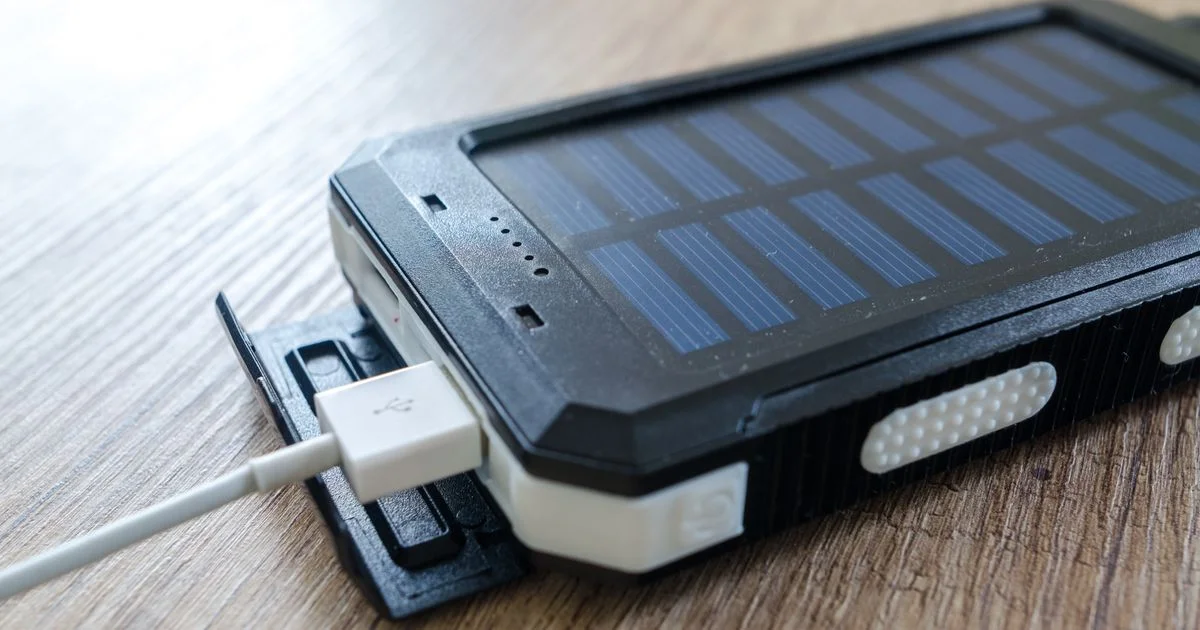
Sunlight is free, which is exactly what makes the little panel on the back of a power bank such an easy thing to sell. A cheap solar power bank puts a photovoltaic strip on a battery you were going to buy anyway and asks for a premium in return, and the honest question is not whether the panel works but how much charge it realistically puts back in a day. This guide sorts the category by what the battery costs, what the panel adds, and the one situation where that panel earns its keep.
This is an independent editorial comparison. We are not affiliated with any brand mentioned, and no brand reviewed or approved this article.
What you are actually paying for
Two things sit inside the case, and they are wildly different in value. The first is the battery pack and its charging circuit, which is the part that does almost all the work. The second is a small solar panel bonded to the lid, which on most consumer units measures roughly 60 to 100 square centimeters and carries a rated output somewhere between 2 and 7 watts.
That rating is where expectations go wrong. A bank advertising a 5-watt panel typically delivers something closer to 1.5 to 3 watts of effective charging power once real conditions are accounted for, against 5 to 18 watts from an ordinary USB wall charger. The charge controller inside adds its own 5 to 15 percent conversion loss on top. You are paying a premium for a component that, on the same clear afternoon, moves roughly a tenth of the power a wall socket moves.
The rugged housing is the quiet third cost. Most solar banks ship in a thicker, gasketed, carabiner-friendly case, and that shell is often the part you actually benefit from — but it is sold to you as a solar feature rather than as a durability feature.
What the built-in panel really delivers
Numbers make this concrete. Filling a 10,000mAh bank takes roughly 15 to 25 hours of sun from an integrated panel, against 4 to 5 hours from a basic 5-watt USB charger or 2 to 2.5 hours at 18 watts. Step up to a 20,000mAh bank and the panel needs something like 30 to 50 hours of sun, while an 18-watt charger finishes in 4 to 5 hours.
Thirty to fifty hours of usable sunlight is not an afternoon. Spread across realistic daylight with the panel actually facing the sky, it is closer to a week of good weather for one full refill. One retailer of outdoor charging gear describes built-in panels plainly as being for emergency use only, and that is a fair summary of what a budget solar power bank panel does: on a clear day with good exposure you might gain enough charge to top up a phone once.
The panel is not fake. It is simply slow in a way the packaging photograph never conveys.
Free and cheaper alternatives
The cheapest fix for a flat battery is the outlet you already own. Charging a bank to full before you leave costs nothing beyond the electricity and takes a couple of hours, and for the overwhelming majority of trips — a festival, a long flight, a day hike, a commute — that is the entire solution. An affordable solar power bank bought for a use case that has a wall socket in it is a premium paid for nothing.

If capacity is the actual problem, a plain high-capacity bank gives you more stored energy per dollar and per ounce than a solar model of the same price, because none of the budget went to a panel. Our guide to the fastest charging power banks covers how to read output wattage properly, which matters far more day to day than any solar rating.
It is also worth knowing how much energy you are really buying. Manufacturers rate capacity at the cell’s nominal 3.7 volts, but output runs at 5 volts, and the conversion is only about 80 to 85 percent efficient. Anker’s own published explanation works the arithmetic through: a 20,000mAh pack is about 74Wh at the cell, roughly 60.7Wh after conversion, and delivers somewhere near 2.8 phone charges rather than the four a shopper might assume. That gap applies to every bank, solar or not.
What you get at each tier
Three tiers cover the market, and the jump that matters is not the one buyers expect.
- Entry-level: a modest battery, a small integrated panel, one or two USB-A ports and slow input. The panel is decorative in practice, and the charging speed in both directions is the real compromise.
- Mid-range: a bigger cell, USB-C in and out with proper fast charging, a genuinely sealed case and a brighter flashlight. The panel is still small; what improved is everything around it.
- Serious off-grid: a plain high-capacity bank paired with a separate folding panel, bought as two items. This is the only configuration where solar charging stops being a novelty, because panel area is the variable that was limiting you all along.
Notice what that progression says. Paying more inside the solar-bank category mostly buys you a better battery, not a better panel — the panel barely grows, because there is only so much lid to cover. That is also why a solar power bank under $35 and a considerably dearer one often carry panels of almost identical size: the lid is the constraint, not the budget.
| Option | Best for | What the money buys | Trade-off |
|---|---|---|---|
| Plain power bank | Almost everyone, almost always | Maximum stored energy per dollar and per ounce | Useless once it is flat and there is no outlet |
| Entry solar bank | Buyers who want a rugged case and an emergency trickle | Durability, a flashlight, a very slow backup | Panel adds days, not hours, of charging |
| Mid-range solar bank | Campers with occasional outlet access | Faster USB-C charging and a properly sealed shell | Still a premium over a plain bank of the same capacity |
| Bank plus folding panel | Multi-day trips genuinely off-grid | Enough panel area to refill a bank in a day | Two items to carry, pack and keep track of |
Where the money is genuinely wasted
Three purchases in this category reliably disappoint.
The first is buying solar for a trip that has outlets in it. The panel then contributes nothing and you have paid extra for weight.
The second is chasing an enormous advertised capacity at the very bottom of the market. Capacity claims are the easiest specification to overstate, and a pack whose real output falls well short of its printed number is a problem the solar panel cannot rescue, since the panel refills that same disappointing cell even more slowly.
The third is treating the panel as your plan rather than your backup. Leaving on a trip with a half-empty bank because it will “charge as you walk” is how people arrive at camp with a dead phone. A panel strapped to a moving pack spends much of the day at a poor angle or in shade.
Buying cheap costs you in one specific way worth naming: the sealed port flaps, the strain reliefs and the case gaskets are the first things to fail on the lowest-priced units, and a bank that lets water into its ports outdoors is worse than no bank at all.
How to decide in five steps
- Count the nights you will genuinely be away from any outlet. If the answer is zero or one, buy a plain bank and stop here.
- Work out how many phone charges you need, then size the bank on real output rather than the printed mAh figure.
- If you do need off-grid power for several days, price a plain bank plus a separate folding panel before looking at integrated units.
- If you still want an integrated solar model, buy it for the rugged case and treat the panel as an emergency extra.
- Whatever you buy, charge it to full from the wall the night before you leave.
Frequently Asked Questions
These are the questions that decide whether the solar version is worth the premium over a plain bank.
How long does a built-in panel take to charge the bank?
Plan on roughly 15 to 25 hours of good sun for a 10,000mAh unit and 30 to 50 hours for a 20,000mAh one. Spread over realistic daylight with the panel angled properly, that is several days rather than an afternoon.
Is a solar power bank under $35 ever a sensible buy?
At the very bottom of the market you are mostly buying a rugged case with a slow battery inside. It can be a reasonable knockabout bank for camping if you judge it on capacity, port quality and durability, and expect nothing meaningful from the panel.
Can the panel charge my phone directly?
Some units allow it, but output from a small panel is too weak and too inconsistent to be useful, and passing cloud will interrupt the charge. Letting the panel trickle into the internal battery and charging the phone from that battery is the more reliable arrangement.
Does a bigger mAh number mean more phone charges?
Only loosely. Capacity is measured at the cell’s 3.7 volts and delivered at 5 volts, and the conversion loses roughly 15 to 20 percent before your phone sees any of it. Expect meaningfully fewer full charges than dividing the two numbers would suggest.
Bottom line
The battery in a solar power bank is worth paying for and the panel almost never is, unless you are spending several days somewhere with no outlet and enough open sky to use it. For everyone else, a plain bank charged at the wall is cheaper, lighter and more dependable — and if you truly need solar, two separate items beat one clever one.


1 Comment
Comments are closed.