

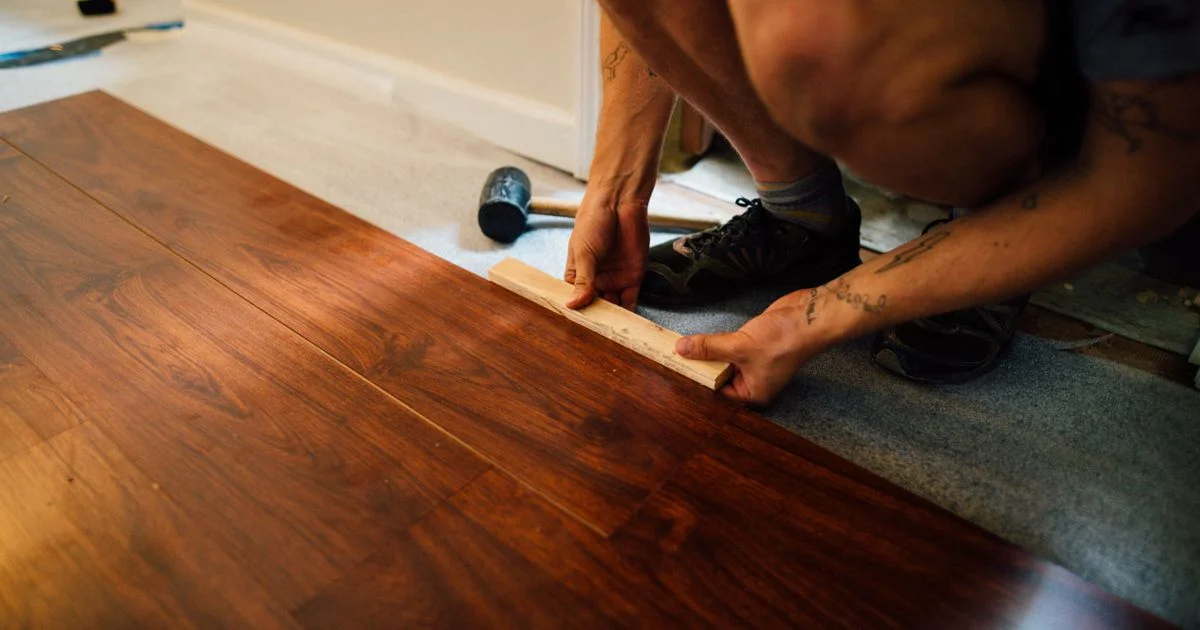
Four separate numbers decide what a new floor costs, and the one printed on the plank is the smallest of them. Home Depot publishes all four on its own estimating page, which makes affordable laminate flooring unusually easy to price honestly before anything is ordered. The shelf figure turns out to be the cheap part of the project.
This is an independent editorial review. Home Depot did not review or approve this article.
The Home Depot is a US home improvement retailer whose store support center is in Atlanta, Georgia, and every figure quoted below was read on its own US pages on 7 October 2026. Published estimates and shelf prices on those pages change without notice.
You can see Home Depot’s own published cost estimate for laminate installation on its official site:
The real total behind affordable laminate flooring
Home Depot lists an average total project cost for laminate installation of “$3.80 – $4.80 per sq. ft.” and breaks that into installation at “$2.00 – $3.00 per sq. ft.”, materials at “$1.50 per sq. ft.” and underlayment at “$0.30 per sq. ft.” On the same page it puts the laminate itself at “$0.79 to $3.00 per sq. ft.” and underlayment at “$0.29 to $0.79 per sq. ft.”
Line those up and the shape of affordable laminate flooring becomes clear. At the bottom of the range the plank is well under a third of the installed figure. Labor is the single largest line on the estimate, and it does not get cheaper when the plank does.
Two more lines sit outside that headline range on the same page. Removing an existing floor runs, “on average,” “$1.95 per square foot.” Moving furniture adds “$35 for up to six large pieces” where it is required. In a room that already has a floor and a sofa in it, both of those lines arrive whether they were budgeted for or not.
- The plank: listed at $0.79 to $3.00 per square foot, and the only line a sale ever touches.
- Underlayment: $0.29 to $0.79 per square foot. Home Depot states that “laminate flooring always requires an underlayment,” so treat it as part of the material cost rather than an upsell.
- Installation: $2.00 to $3.00 per square foot, flat against the plank you chose.
- Taking the old floor out: about $1.95 per square foot, which can rival the new plank.
- Overage: Home Depot’s own guidance is to “order 5 to 10 percent more of your materials,” so the carton count is larger than the room.
What laminate flooring under $1000 actually covers
Run the retailer’s own installed range against a round number and laminate flooring under $1000 stops being vague. At $4.80 per square foot that budget reaches roughly 208 square feet; at $3.80 it reaches about 263. Both figures are before old-floor removal, and both shrink once the five to ten percent overage comes out of the same pot.
A ten-by-twelve bedroom is 120 square feet. A twelve-by-eighteen living room is 216. So a four-figure budget that sounds like a whole floor is, on the retailer’s own numbers, one average room installed, or two rooms if the labor comes out of the equation.
Doing it yourself is where the free-versus-paid line sits
Laminate is the flooring category most often sold on the strength of being installable without a trade, and Home Depot describes the product as coming “in planks, tiles or squares that feature an interlocking tongue-and-groove assembly,” which “simplifies installation.” Taking the installation line out is the single biggest saving available on this project, and it is worth more than any plank discount.
What does not come out is the underlayment, the overage or the transition pieces at every doorway. Home Depot also offers a free flooring measure, and its own advice on the costing page is to “ask for a complete estimate that includes the flooring, the underlayment and the installation costs such as materials and labor.” That sentence is the retailer telling you where its own headline figure is incomplete, which is useful whether or not you hire anyone.
The AC number is the only durability figure with a test behind it
Home Depot sorts its laminate by an AC rating and publishes the ladder as a shopping filter: “AC2: Residential Medium Traffic”, “AC3: Residential Heavy Traffic”, “AC4: Commercial Medium Traffic” and “AC5: Commercial Heavy Traffic”. In the AC4 selection, products ran from “$1.99/sq. ft.” to “$2.89/sq. ft.” at the time of reading.
What the retailer does not do anywhere on those pages is say what the rating means or how it is produced. The rating comes from ANSI/NALFA LF-01, the laminate flooring performance standard, and its wear-resistance clause is a real abrasion test rather than a marketing tier. Intertek, the testing laboratory, describes Section 3.7 as measuring “the ability of the surface of laminate flooring to resist abrasive wear” through the printed decorative layer, with a specimen abraded in repeated cycles until wear spots of at least 0.60 square millimeters, under a thousandth of a square inch, are visible across three quadrants, at which point the cycle count is recorded.
For a value shopper that single number does more work than any other spec on the page, because it is the one figure separating a plank near $0.79 from a plank near $3.00 that somebody actually measured.

What the TSCA Title VI label on the carton is for
Laminate is a photographic layer over a composite wood core, and that core is regulated. The Environmental Protection Agency’s formaldehyde standards cover “hardwood plywood, medium-density fiberboard, and particleboard, as well as household and other finished goods containing these products.” On its laminate flooring page the agency states that the flooring at the center of a widely reported television investigation “must be made with composite wood cores or platforms that are certified as compliant with the formaldehyde emission standards.”
The emission limits are not identical across materials, and the difference matters to anyone choosing a cheaper core. Under 40 CFR 770.10, tested by ASTM E1333-14, the limits are 0.05 parts per million for hardwood plywood, 0.09 ppm for particleboard, 0.11 ppm for medium-density fiberboard and 0.13 ppm for thin medium-density fiberboard. The fiberboard family that sits under a laminate plank is held to roughly twice the plywood figure.
What you get for free is the label. For finished goods produced or imported after 22 March 2019, the EPA requires that labels “include the fabricator’s name, the date the finished good was produced (in month/year format), and a TSCA Title VI compliance statement,” and the agency “recommends that consumers look for products that are labeled TSCA Title VI compliant.” It also notes that it “has not tested or verified the accuracy of home test kits for formaldehyde,” and that many organizations, itself included, “advise that formaldehyde levels be kept as low as reasonably achievable.”
That is a compliance statement on a carton, not a quality grade. It is still the only line on the packaging that somebody outside the supply chain had to sign off.
Two rooms where is laminate flooring worth it gets a different answer
Asking is laminate flooring worth it without naming the room produces an answer nobody can use. Home Depot’s own description says durable laminate options “are ideal for wet bathroom floors, kitchen spills and wear and tear from pets,” which is the retailer’s claim rather than an independent finding.
Set that against the material. The core is fiberboard, the same family the formaldehyde rule exists for, and fiberboard is the component that reacts to standing water. In a bedroom, a hallway or a living room, the trade-off is comfortably in laminate’s favor at the budget end, and the cleaning routine matters more than the plank does, as our steam mop cost guide sets out. In a full bathroom or a laundry room, the honest reading is that the retailer’s water claim is the claim to check against the specific product’s own written warranty before the cartons are opened, because that is the document that will decide a dispute.
What the budget laminate flooring deals 2026 column is really discounting
The budget laminate flooring deals 2026 shoppers see will be discounts on the plank, because that is the line the retailer controls on the shelf. Installation is quoted as a service, underlayment is a near-fixed per-foot cost, and removal is labor. A plank sale moves the smallest of the four numbers.
- Price the room, not the square foot, using the installed range rather than the shelf figure.
- Add five to ten percent for overage before comparing any two quotes.
- Decide the installation question first, since it is worth more than every plank discount combined.
- Filter by AC class before filtering by price, so the discount is measured against a tested durability figure.
- Check the carton for the TSCA Title VI compliance statement, the fabricator name and the month and year of production.
| Where the money goes | Does a sale reach it? | Can you remove it yourself? | Value read-out |
|---|---|---|---|
| Laminate plank | Yes, regularly | No | The smallest line on the installed estimate |
| Underlayment | Rarely | No; the retailer says it is always required | Small, fixed and easy to forget in a budget |
| Installation labor | No | Yes, if the room is simple | The largest single line, and flat against plank price |
| Old floor removal | No | Sometimes | Can match or beat the cost of the new plank |
| Overage and transitions | No | No | A predictable percentage nobody quotes upfront |
Where the money is genuinely wasted
Four lines on a laminate project reliably take money without improving the floor.
- Paying trade installation rates to lay the cheapest plank available. The labor figure is flat. Spending $2.00 to $3.00 per square foot to install a $0.79 board is the one combination that makes no sense in either direction.
- Skipping the overage. Reordering mid-job risks a different production run, and the production date is printed on the carton precisely because runs differ.
- Buying premium underlayment for a plank that already has it attached. Check the product page before adding a roll to the cart.
- Paying for removal and haul-away of a floor that lifts out. At about $1.95 per square foot this is often the second-largest line on the estimate.
You can read the retailer’s own figures for yourself here:
Frequently Asked Questions
These come up once the plank has been chosen and the rest of the estimate arrives.
Why is the installed price so much higher than the shelf price?
Because the shelf price is one of four lines. On Home Depot’s own estimate, installation is $2.00 to $3.00 per square foot against a plank at $0.79 to $3.00, with underlayment and any old-floor removal on top of both.
What does the AC rating on a laminate plank mean?
It is a wear-resistance class from the ANSI/NALFA LF-01 standard, produced by abrading a sample in repeated cycles until a defined area of wear appears. Home Depot publishes the classes as filters, from AC2 for residential medium traffic to AC5 for commercial heavy traffic, without defining them on the page.
Does laminate flooring have to be labeled for formaldehyde?
Finished goods containing regulated composite wood and produced or imported after 22 March 2019 must carry a TSCA Title VI compliance statement, the fabricator’s name and the month and year of production. The EPA recommends shoppers look for that statement.
How much extra flooring should be ordered?
Home Depot’s own square-footage guidance is to order five to ten percent more material than the measurement, which covers cuts and mistakes and leaves matching stock for later repairs.
Bottom line
The plank is the cheapest thing in a laminate project on the retailer’s own published numbers, and it is the only line a discount reaches. Decide the installation question before the color, filter by AC class before price, and read the compliance statement on the carton, which is the one piece of information nobody charged you for.


2 Comments
Comments are closed.