

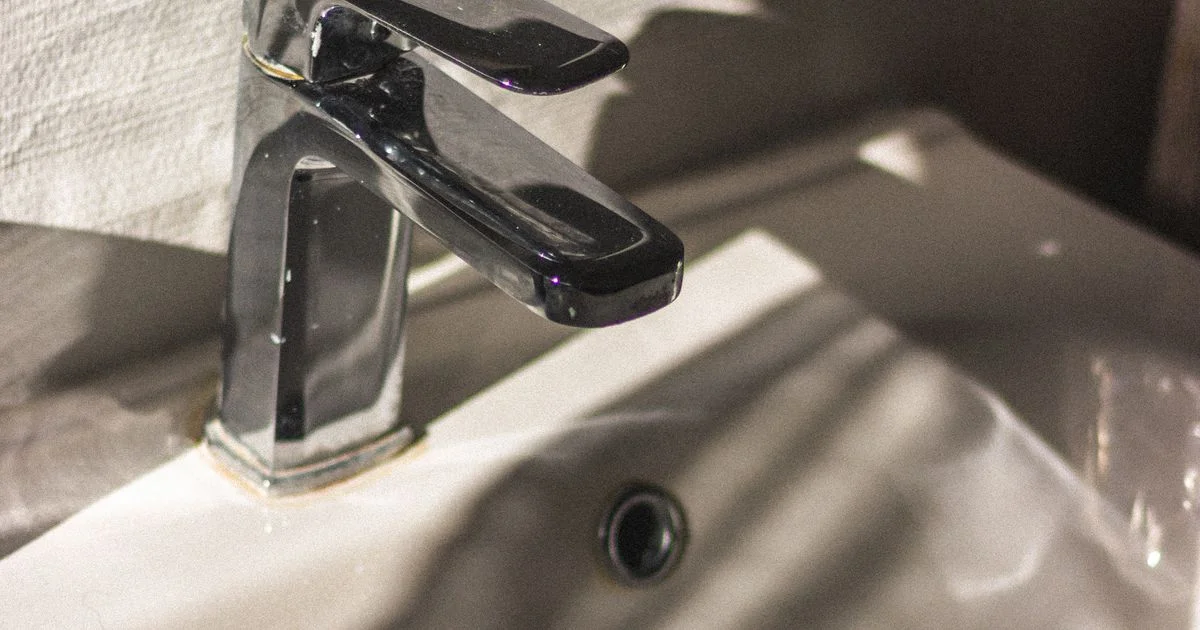
A bathroom faucet is one of the few things in a house where the budget question is largely settled before you start shopping. Federal rules already decide how much water is allowed to come out of it, and Ferguson’s own catalog has mostly settled well under that limit, so a bathroom faucet under $100 and one at five times the price fill the same glass at about the same speed. The extra money is buying something, but it is not buying water.
This is an independent editorial review. Ferguson did not review or approve this article.
Ferguson Enterprises Inc. is a Delaware corporation headquartered in Newport News, Virginia, and its own Terms of Site Use state that the site is intended for use only by individuals in the United States, so every policy line, window and figure quoted here was read on its US pages on 8 October 2026 and is the US version. Local plumbing codes and permit rules are not covered here.
You can see Ferguson’s current bathroom sink faucet range on its official site:
What a bathroom faucet under $100 actually has to cover
The number on the faucet is one line on a longer list, and on a replacement job it is often not the biggest one. A bathroom faucet under $100 is the hardware alone, and Ferguson’s own Terms and Conditions of Sale are explicit that the quoted figure is not the landed figure: “All taxes, transportation costs, duties and other charges are in addition to quoted prices.” Orders ship “FCA, Seller’s facility” under the Incoterms 2020 rules, which means risk of loss passes to the buyer when the goods are tendered, not when they arrive on the doorstep.
The lines that turn a sub-$100 purchase into a bigger one:
- The drain assembly. Some listings include one and some do not. Ferguson’s house label PROFLO lists a single handle centerset faucet with a drain assembly in the product name, which tells you the rest of the shelf may not.
- Supply lines. Braided connectors are cheap, but the old ones are the wrong length roughly as often as they are the right one.
- Shipping. Added to the quoted price, per the terms above.
- Sales tax. Also added, and Ferguson states prices “do not include applicable taxes.”
- A shutoff valve. If the valve under the sink does not turn, the swap stops being a faucet job.
- Labor. Nothing at all if you do it yourself, and comfortably more than the faucet if you do not.
That is the honest read on the entry tier. The hardware is genuinely cheap. The project is not automatically cheap with it.
Where an affordable bathroom faucet is honestly enough
Before the faucet is the question, the aerator usually is. The EPA’s WaterSense program treats the two as alternatives rather than as a sequence, telling homeowners to install “WaterSense labeled faucets and/or faucet accessories (e.g., aerators) in all bathroom sinks” and to “CHECK the gpm marking on the faucet or faucet aerator.” An aerator is a screw-in part that costs a rounding error against any faucet, and if the valve underneath still works and the finish still looks acceptable, it captures most of the water saving on its own.
The saving is worth putting a number on. The EPA says a labeled bathroom faucet or accessory “can save the average family 700 gallons of water per year, equal to the amount of water needed to take 45 showers,” and “nearly 11,000 gallons of water over the faucets’ lifetime.” Those figures belong to the flow restriction, not to the price tag, which is exactly why an affordable bathroom faucet captures them as completely as an expensive one does.
Replace the whole faucet when the valve drips, when a handle has gone loose at the base, or when the hole layout is changing anyway. Replace the aerator when none of that is true.
Ferguson lists 1,966 bathroom sink faucets and prices none of them
This is the part that makes a budget search awkward, and it is worth knowing before you open a tab. Ferguson’s bathroom sink faucet category carried 1,966 products when it was read for this article, and not one of them displayed a price. Every listing reads “Call for Pricing” with a phone number instead. The site is built for trade accounts, and trade pricing is quoted rather than published.
The consumer-facing Ferguson Home side does print figures, in the form of “Starting At” prices inside its own guide to choosing a bathroom faucet. On the day it was read, the lowest listed option in that guide started at $124.42 and the highest at $761.58. That guide is a curated style gallery rather than the full catalog, so it is not evidence that nothing cheaper exists in 1,966 products. It is evidence that the price ladder Ferguson chooses to show a homeowner begins above $100.
Treat both figures as a reading taken on one day. Ferguson’s terms say plainly that “All prices are subject to change unless otherwise noted on Seller’s applicable quotation.”
The flow rate is capped, and the catalog already sits under the cap
Here is the fact that does most of the work in this category. The EPA describes “the standard flow of 2.2 gallons per minute” as the federal standard for a bathroom sink faucet. Its WaterSense label goes further, covering faucets that “use a maximum of 1.5 gallons per minute (gpm) at 60 pounds per square inch (psi),” and because a trickle is not a feature either, WaterSense also “established a minimum flow rate for WaterSense labeled lavatory faucets (i.e., 0.8 gpm at 20 psi).”
Now read Ferguson’s own flow rate filter against that. Of the 1,966 faucets in the category, 1,289 are listed at 1.2 gpm. Only 40 are at the 2.2 gpm federal standard. Another 116 are at 1.5 gpm and 100 at 1.0 gpm. The market has already standardized a long way below the legal ceiling, which means the difference between the cheap faucet and the expensive one is not how much water arrives.
One number in that filter is a genuine trap for a bargain hunter: 338 of the listings are 0.5 gpm. Those are public restroom fixtures. The EPA’s own guidance says a public lavatory faucet should run at “0.5 gallons per minute or less” to count as efficient, and then adds that “Flow rates of 0.5 gallons per minute or less are not appropriate for use in private lavatories.” A cheap commercial faucet filtered to the top of a price-sorted list is cheap for a reason that has nothing to do with a bargain.
Lead free is a legal floor, not a feature
Marketing copy treats lead-free construction as a selling point. Federal law treats it as the minimum condition for being sold at all. The Safe Drinking Water Act defines “lead free,” at 42 U.S.C. 300g-6(d)(1)(B), as “not more than a weighted average of 0.25 percent lead” “when used with respect to the wetted surfaces of pipes, pipe fittings, plumbing fittings, and fixtures.” The same section, at 300g-6(a)(3)(A), makes it unlawful “for any person to introduce into commerce any pipe, or any pipe or plumbing fitting or fixture,” “that is not lead free.”
So a lead-free claim on a premium faucet and the absence of that claim on a budget one describe the same legal obligation. It is not a tier. Paying more does not buy a safer wetted surface, and paying less does not forfeit one.

Working out is bathroom faucet worth it for the sink you already own
The budget risk in this category is almost never the faucet. It is the sink deck, which is why is bathroom faucet worth it is really a question about the holes already drilled in it. Ferguson Home’s guide puts the warning plainly, telling shoppers to “Be sure to note how many installation holes are available before you make any purchases,” because a mismatched layout can turn a straightforward swap into a remodel that needs a new sink or vanity. A $90 faucet that forces a new vanity is the most expensive faucet on this page.
Measure in this order before anything goes in a cart:
- Count the holes in the deck. One, three, or none at all if the current faucet is on the wall.
- Measure the faucet centers, which the guide describes as the distance “from the very center of the left hole to the very center of the right hole.”
- Check the clearance behind the holes, to the wall and to anything mounted on it.
- Decide the installation type from those two numbers, not from a photograph.
- Only then look at finish and shape.
Ferguson’s guide sorts the types the same way. A centerset is “a very popular installation type” with the spout and handles on one base. A widespread has separate pieces and “the most style variety and options,” with centers reaching as far as 16 inches. A single-hole faucet goes “into a single hole on the back of the sink or vanity,” and an escutcheon or deck plate can cover holes you are not using, which is the cheapest way out of a layout mismatch. A wall-mount needs “a wall mounted valve connection, which can be a more expensive project.”
What you get at each tier
Strip out the water and the lead rules and the remaining differences are material, mechanism, finish and who stands behind it. That last one matters more at Ferguson than at a general retailer, because its Terms of Sale say “Seller warrants only title to the Products sold to Buyer” and that “All other warranties are those extended by the product manufacturer,” and the terms then disclaim all other express or implied warranties. At every tier, the warranty you are actually relying on is the faucet maker’s.
| What you are paying for | Entry tier | Mid tier | Premium tier |
|---|---|---|---|
| Body material | Often zinc alloy or plastic internals | Brass body becomes common | Solid or cast brass, which Ferguson’s guide calls the preferred material |
| Valve mechanism | Ceramic disc is widespread even here | Ceramic disc, better seals | Ceramic disc, longer service parts availability |
| Flow rate | Usually 1.2 gpm already | Usually 1.2 gpm | Often 1.2 gpm or lower |
| Lead-free wetted surfaces | Required by law | Required by law | Required by law |
| Finish range | Chrome, sometimes brushed nickel | Nickel and black tones | Gold and brass tones, matched accessory lines |
| Drain assembly | Sometimes included, read the title | Varies by line | Frequently sold as a coordinated extra |
| Who honors the warranty | The manufacturer | The manufacturer | The manufacturer |
Ferguson’s own finish filter shows where the style money sits: chrome tones cover 1,264 listings and nickel tones 598, while gold tones account for 198 and brass tones 114. The scarce finishes are the expensive ones, and a finish is the only thing on that list doing nothing mechanical.
What the bathroom faucet deals 2026 listings are actually discounting
A faucet is a durable good with no subscription attached, so a discount here is a genuine discount rather than an introductory rate. The fine print still matters. Ferguson states that “Promotional prices and discount offers are valid only during the applicable period established for the program,” and reserves the right to cancel an order “listed at an incorrect price due to any error.” Its site terms also decline to warrant that product descriptions on the site are accurate or complete. Read a bathroom faucet deals 2026 listing for the specification, then confirm the specification against the manufacturer’s own page before ordering.
The return path is the part worth reading twice on a cheap faucet, because the friction does not scale down with the price:
- Thirty days, stocked items only. “Within 30 days of purchase, Buyer may return any Products which Seller stocks and which are not special order items.”
- Original packaging, intact. The goods must be “in new condition, suitable for resale in undamaged original packaging and with all original parts.” A faucet test-fitted and unwrapped is a harder return than one still boxed.
- A restocking fee with no published rate. “All returns are subject to a re-stocking fee, unless otherwise agreed to by Seller.” The percentage is not stated anywhere on the policy, so on a sub-$100 item the fee is an unknown share of a small number.
- Special orders sit outside all of it. They “may be returned if the manufacturer is willing to accept the return,” and the buyer reimburses any fee the manufacturer charges.
- No self-service cancellation. “Buyer may not cancel or modify an order without the written consent of Seller,” and “You cannot cancel an order on the Website.”
Where the money is genuinely wasted
Four places, in rough order of how often they catch people.
Paying for water efficiency you already have. Two thirds of the catalog sits at 1.2 gpm regardless of price, so a premium for a low flow rate is a premium for the default.
Paying for a lead-free claim. It is the condition of sale, not an upgrade.
Buying the finish first. If the budget is tight, a chrome version of a better body beats a gold version of a worse one.
Electronic and touchless features on a home lavatory. They add a power source, a sensor and a failure mode to a device whose job is to open and shut.
And the mirror image, where buying cheap genuinely costs you later: a zinc body with plastic internals on the sink that gets used every morning, a faucet chosen before the holes were counted, and a commercial 0.5 gpm fixture bought because it sorted to the top of a price list.
You can check Ferguson’s current lineup and specifications on its official site:
Frequently Asked Questions
Four questions come up more than any others once the flow rate and the hole count are understood.
Does a more expensive faucet give stronger water pressure?
No. Pressure comes from the plumbing, and the volume that reaches the basin is limited by the faucet’s rated flow. The EPA puts the federal standard at 2.2 gallons per minute, and most of Ferguson’s catalog is listed at 1.2 gpm whatever it costs. A premium faucet frequently delivers less water than a budget one, by design.
What does the gpm number on a faucet box mean?
It is the maximum flow the faucet is rated to deliver, measured at a set pressure. WaterSense labeled lavatory faucets are capped at 1.5 gpm at 60 psi and must also manage at least 0.8 gpm at 20 psi, so the label carries a floor as well as a ceiling. The EPA’s advice is to check that marking on the faucet or on the aerator.
Is a 0.5 gpm faucet a good way to save money on water?
Not in a home bathroom. The EPA treats 0.5 gallons per minute or less as the efficient target for public restrooms and states that those flow rates “are not appropriate for use in private lavatories.” Those listings exist in the catalog because commercial buyers need them.
Can a faucet bought from Ferguson be returned if it does not fit?
Possibly, within thirty days, if the item is one Ferguson stocks rather than a special order, and if it comes back in new condition in undamaged original packaging with all original parts. A restocking fee applies, and the policy does not publish the rate. Measuring the hole spacing first is cheaper than finding out.
Bottom line
Federal rules and Ferguson’s own catalog have between them removed water and lead safety from the price conversation, which leaves body material, the valve, the finish and the hole count. Count the holes, buy the brass body over the gold finish, and keep the box until the faucet is running.


2 Comments
Comments are closed.